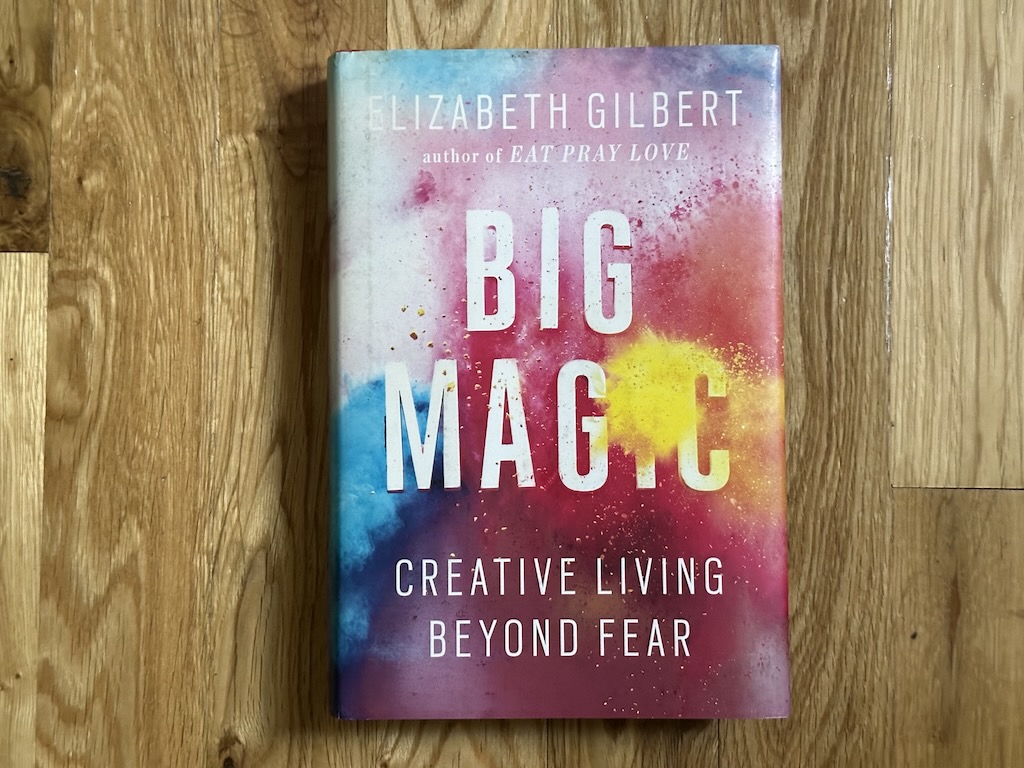
Five take-aways from Elizabeth Gilbert’s Big Magic: Creative living beyond fear. You can think of this as part-notes, part-thoughts, part-action items from my reading of this book at this time.
1. Courage.
The universe buries strange jewels deep within us all, and then stands back to see if we can find them. (p8)
Do you have the courage to find these jewels? What have you been curious about lately? And what would it take to explore that curiosity more deeply?
It might very well be the case that you have no idea what sparks your curiosity. We are often so busy dealing with the practicalities of our current situation in life that it precludes us from spending time and energy thinking about the things that bring us true joy. It’s also true that we don’t have to continue living life in this way, but we must have the courage to explore our own internal universe to find a path towards our true nature.
Self-reflective activities like journaling and/or time with a coach can help us discover a thing or two we’re deeply curious about and also help us make space for exploring what is revealed throughout the course of this work.
And when we are working towards our creative pursuits, it’s essential to keep fear in the picture. Don’t kill it. Doing so risks killing our creativity along with it. Instead, name fear. Make space for it. And, (mostly) ignore it. You absolutely must not let fear make all of your decisions for you.
We simply do not have time anymore to think so small. (p27)
2. Enchantment.
Ideas are disembodied, energetic life form. (p55)
Ideas have one goal: to be manifest. They are trying to find a human collaborator to bring them into our collective reality. To the open individual, they come as inspiration and have a feeling in the body like chills, hairs on the back of the neck standing up, feeling sick, dizzy, like falling in love, or even something dangerous.
When ideas come along we have two options:
- No — “I’m honored by your visitation, but I’m not your person. May I respectfully suggest that you call upon, say, [Insert Worthy Person’s Name Here]?” Gilbert mentions that she always tries to use her most gracious manners when sending an idea away; you don’t want word getting around the universe that you’re difficult to work with. (p37)
- Yes — You can go the tortured artist route (don’t do that) or “cooperate fully, humbly, and joyfully with inspiration” (p40). Get serious about the idea and make space for it.
The Greeks and Romans believed in the idea of an external daemon of creativity, like having a house elf. YOU are not a genius. YOU HAVE a genius. This takes the pressure off, but it also means that you must do the daily work to bring the ideas brought to you by the universe into reality.
Ideas are looking for the quickest way to become reality. If you’re the right person and have done the work to be ready to bring the idea into this world, take it and make it happen. But when an idea moves on, it’s likely found someone else more capable and it’s time to graciously let it go.
Something unknown is doing we don’t know what. — Sir Arthur Eddington
3. Permission.
You will never be able to create anything interesting out of your life if you don’t believe that you’re entitled to at least try. (p92)
You don’t need permission to live a creative life. You are here, therefore you are entitled to do so. Period. The End.
I think it’s a mighty act of human love to remind somebody that they can accomplish things by themselves, and that the world does not automatically owe them any reward, and that they are not as weak and hobbled as they may believe. (p116)
True originality comes from authenticity. Whatever it is that you decide to create, ensure that it’s authentic to you.
Entertain yourself, not others. We don’t need more slop in the world created for absolutely nobody who wanted or needed it in the first place. Create for you.
Create whatever causes a revolution in your heart. (p101)
Live lightly. Fuck seriousness. Play.
4. Persistence.
If you want to be a professional artist, but you aren’t willing to see your work rejected hundreds, if not thousands, of times, then you’re done before you start. — Mark Manson
Be childlike in your pursuit of creativity, not childish — that’s dangerous (p153). Take care of yourself and your creativity at the same time. Don’t force your creativity to provide for yourself; that’s often a mistake and will scare away your creativity. Just, get a job.
With your creativity — take vows, practice, learn your craft — it’s never too late. Keep at it.
So many of us believe in perfection, which ruins everything else, because the perfect is not only the enemy of the good, it’s also the enemy of the realistic, the possible, and the fun. — Rebecca Solnit
5. Trust.
The exchange of love between earth and people calls forth the creative gifts of both. The earth is not indifferent to us, but rather calling for our gifts in return for hers — the reciprocal nature of life and creativity. — Dr. Robin Wall Kimmerer
Many people believe that humans are a cancer on Earth. I don’t believe this to be true. I believe that we CAN be a cancer and we can also be a source of great healing. And to do that, we must trust the universe and work with nature, not against it.
I can always steady my life once more by returning to my soul. I ask it, “And what is it that you want, dear one?” The answer is always the same: “More wonder, please.”
What do you love doing so much that the words failure and success essentially become irrelevant?
Answer this question honestly, and get to work. Make it happen. The universe needs your collaboration. You win, and so does everybody else.
What’s at stake if you don’t pursue this? Don’t know? If you are doing it because it brings you alive, have fierce trust in the process. You never know where it’s going to take you.
Let go. Love. Play. Be child-like in your creative pursuits, keep at it, and trust the process.